
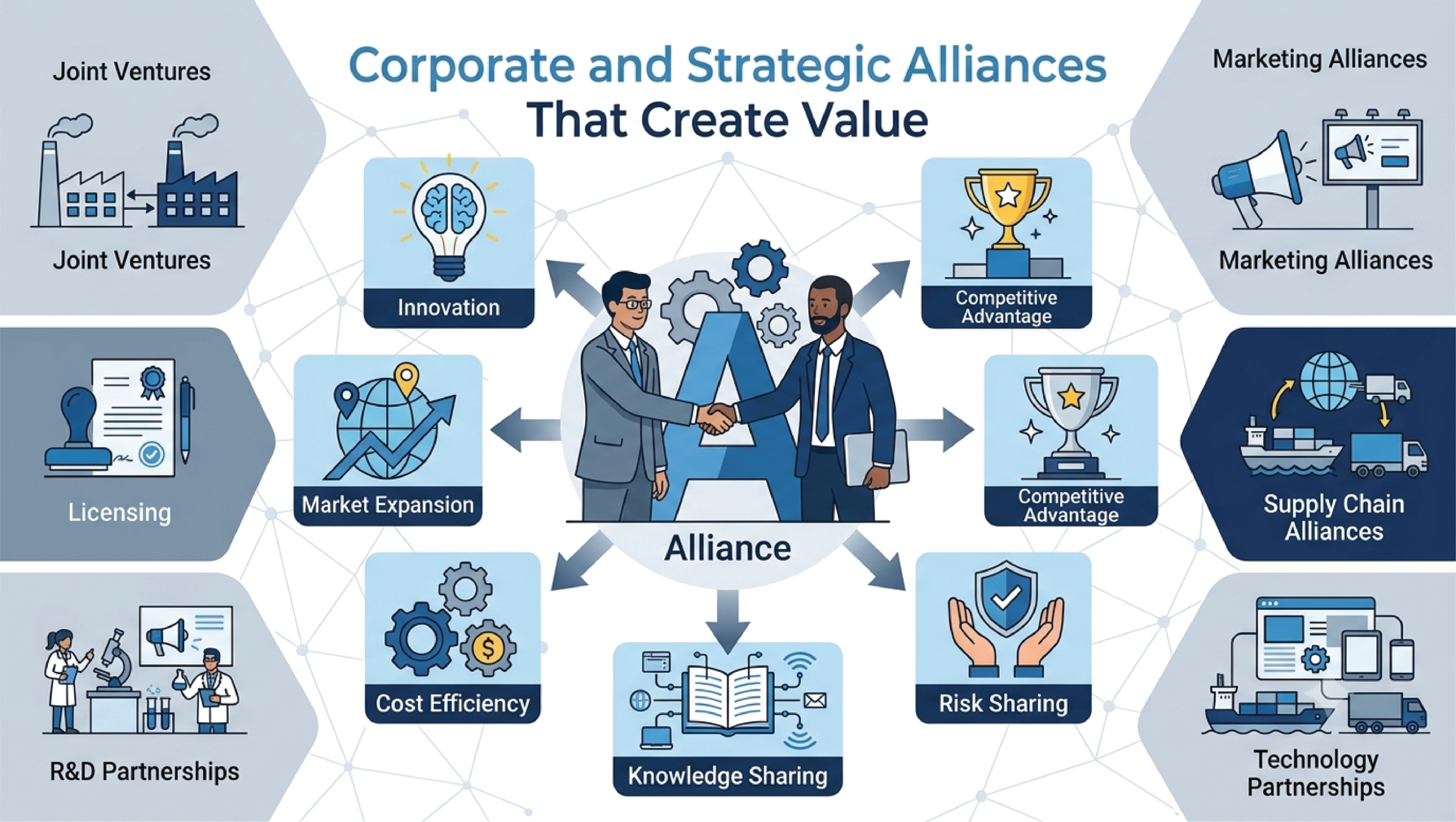
Corporate and strategic alliances are formal partnerships between established, independent companies that collaborate to achieve shared goals aimed at success. Both parties retain control over their respective companies, and collaborating with another company requires a team to combine the strengths of each organization.
These partnerships are crucial, as development and growth depend on speed, expertise, and access to new markets. To evaluate strategic alliances quickly and accurately, you need to have a deep understanding of what a strategic alliance is, when it should be implemented properly, and how both parties create value.
What Is a Corporate Strategic Alliance?
A corporate strategic alliance is a business partnership with broader objectives than a simple agreement with a supplier. For example, one company might contribute technology, while another contributes a distribution network or brand recognition for the products to be marketed.
A merger combines ownership, whereas an acquisition involves the transfer of control of one company to another. Alliances keep the two companies separate, but often involve shared goals, shared risks, and shared resources.
The most common models include joint marketing, to reach the same audience; technology partnerships, for product integration; distribution agreements, for access to distribution channels; licensing, for the lawful use of intellectual property; and joint innovation, to develop a new offering together.
Why Do Companies Form Partnerships Instead of Operating Alone?
Companies form partnerships because operating alone is considerably slower and involves slightly higher operating costs. By establishing the right partnerships, companies can shorten time to market, reduce operating and other costs, acquire capabilities they currently lack, expand their customer reach, and slightly reduce risk in an uncertain market.
How Alliances Can Evolve from Concept to Launch
A strong alliance begins with the identification of a clear business gap and the desired outcomes. Next, leaders must seek out a partner who can help address that gap.
What Makes a Partner a Good Fit
A good fit starts with building a shared strategy, aligned cultures, combining complementary strengths, and overlapping markets. The partner should always address real weaknesses, not duplicate what your team is already doing well.
Key Terms to Keep the Alliance on Track
The agreement requires structure. Define the scope, decision-making authority, KPIs, confidentiality, exit clauses, and escalation pathways. Designate point persons on both sides, as clear governance will prevent confusion when the sales, product, and legal teams are pulling in different directions.
How to Measure Success and Avoid Failure
An alliance is successful only if it can maximize business results. Leaders must also measure results related to the original reasons for forming the partnership.
Metrics That Indicate the Alliance Is Performing Well
Useful metrics include pipeline growth, shared leads, operational cost savings, product adoption, achievement of key milestones, and speed to market. Each metric must also be tied to the alliance’s objectives; otherwise, the dashboard will be nothing more than irrelevant data.
Critical mistakes that can undermine a partnership
Be aware from the outset that a partnership will collapse if its direction is unclear or if there is no executive sponsor to step in when priorities clash. Slow approval processes can also hinder critical momentum, so both parties need to conduct regular reviews after launch.
Choosing the Right Partnership
The best partnerships for a company can create significant value because both companies contribute in unique ways and consistently work well together to achieve shared goals.
Choose the right partner, establish crystal-clear guidelines, and review progress regularly before small issues turn into larger, more serious problems.
Choosing a business partner is a strategic decision that will determine the success or failure of your business. The right partner not only brings capital or expertise, but also serves as a moral anchor and a reliable sounding board to help take your business to the next level.
Take the time to carefully screen, evaluate, and formalize your partnership to ensure a sustainable future for your business.